 How-to
Carpet Beetle Eggs in Wool Rug Fibres: What to Look For
Last Updated: November 14, 2026
Quick Summary
Carpet beetle eggs in wool rug fibres are tiny, pearl-white ovals roughly 0.5mm long, glued singly or in small clusters to the base of the pile where it meets the backing. Eggs are most often found along rug edges, under furniture and in soiled patches. This guide shows you exactly where to look, what to look for, and how to deal with them safely.
- The carpet beetle life cycle runs from egg to adult in roughly two to six months indoors.
- Eggs hatch in about two weeks in warm indoor conditions, and only larvae feed on wool.
- Inspect from the underside up, lifting every edge and checking dark, undisturbed zones first.
- Vacuuming the whole rug before identifying the problem can spread eggs and larvae.
- Freeze infested loose textiles for at least 72 hours to kill eggs and larvae.
Table of Contents
- Carpet Beetle Eggs in Wool Rug Fibres: The Identification Basics
- Carpet Beetle Life Cycle: Eggs, Larvae and Adults
- How to Identify Carpet Beetle Larvae in Wool Rugs
- How to Inspect a Wool Rug for Carpet Beetles
- Carpet Beetles Versus Clothes Moths in Rugs
- How to Get Rid of Carpet Beetles in a Wool Rug
- Book a Professional Wool Rug Inspection
- Frequently Asked Questions
Carpet Beetle Eggs in Wool Rug Fibres: The Identification Basics
Most people spot the damage before they spot the cause. A bald patch appears.
That grub is the real problem. The eggs are just the beginning.
Carpet beetle eggs are the starting point of an infestation that can quietly destroy a wool rug over several months.
Below, we break down the identification basics, the life cycle, and the practical steps that actually work.
Carpet Beetle Life Cycle: Eggs, Larvae and Adults
The carpet beetle life cycle runs from egg to larva to adult in roughly two to six months indoors, depending on warmth and food supply. Only the larva stage feeds on wool, and that is the stage that causes visible damage to a rug.
Here is how each stage behaves:
- Eggs: Laid near a food source, not randomly. Hatch in about two weeks in warm indoor conditions.
- Larvae: The destructive stage. Bristly, brownish and light-shy. They feed on protein fibres.
- Adults: Small, oval beetles that fly. They lay the next generation and do no fibre damage themselves.
The University of Kentucky entomology guidance on carpet beetles notes that a single female can lay dozens of eggs on or near vulnerable materials. That is why one visible grub usually means more are hidden.
Watch out: killing adult beetles does nothing to stop the larvae already feeding. You have to find the eggs and larvae, not just the adults.
How to Identify Carpet Beetle Larvae in Wool Rugs
Carpet beetle larvae are small, segmented grubs with brown bands and stiff bristles, usually 4-5mm long, and they curl up when disturbed.
Here is how to tell them apart from other household pests:
| Feature | Carpet Beetle Larva | Clothes Moth Larva | Flea Larva |
|---|---|---|---|
| Appearance | Bristly, banded brown | Creamy, silken case | Tiny, worm-like |
| Where found | Deep in pile, under rug | In folds, dark corners | In carpet, near pets |
| Damage pattern | Irregular bald patches | Grazed surface, holes | No fibre damage |
| Movement | Slow, curls when touched | Slow, hides in case | Fast, jumps as adult |
The bristles are the giveaway. Moth larvae are smooth and often carry a silken tube. Flea larvae are barely visible and do not eat wool.
A common mistake is assuming any small grub is a moth larva and treating for the wrong pest.
How to Inspect a Wool Rug for Carpet Beetles
To inspect a wool rug for carpet beetles, work from the underside up, lift every edge, and check the dark, undisturbed zones first. Eggs and larvae cluster where wool meets dust, hair and debris.
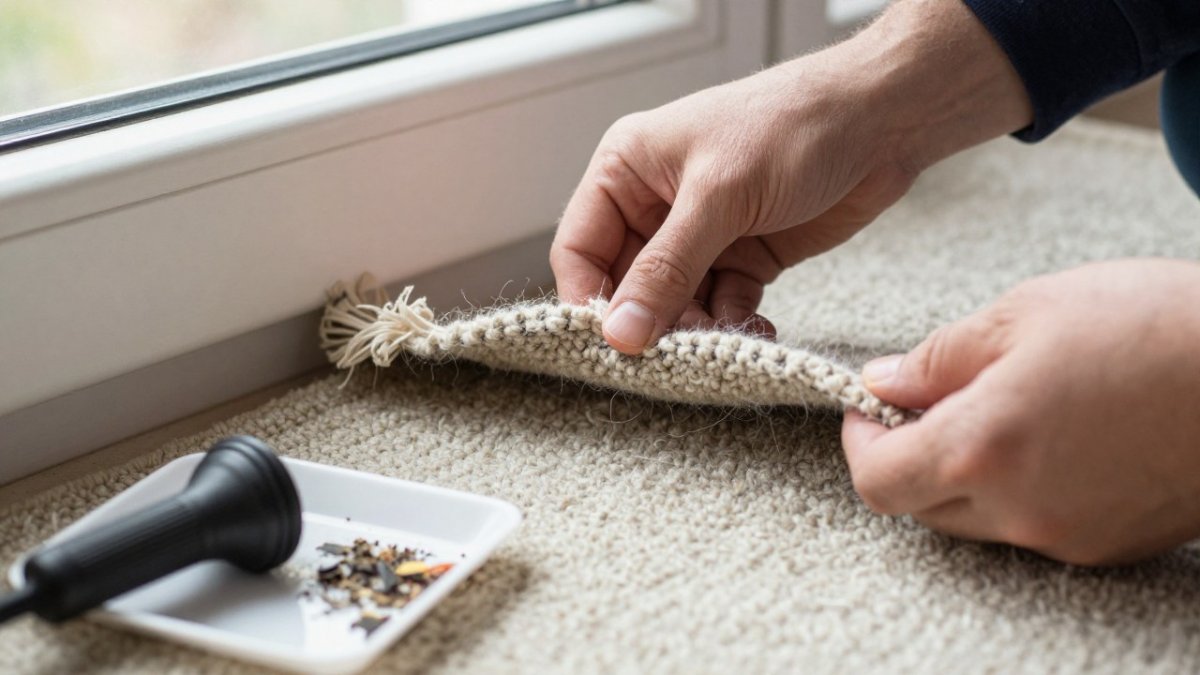
What eggs actually look like in the fibres
Carpet beetle eggs are roughly 0.5mm long, smaller than a grain of coarse salt, and pearl-white to cream in colour. They are oval and slightly translucent, and they are glued to the fibre rather than resting loosely on it.
In situ, they are easy to confuse with:
- Lint and fibre pills: these are irregular, fibrous and squash flat; eggs are smooth, uniform ovals that hold their shape.
- Dust and grit: this scatters loosely when disturbed; eggs stay stuck to the fibre until dislodged.
- Moth eggs: similar in size but usually laid in folds and dark storage areas rather than across the open pile.
A hand lens or a phone camera in macro mode makes the difference obvious. If a white speck brushes off with a single fibre attached and leaves a clean spot, it was debris.
A safe inspection sequence
- Clear the area first. Move furniture, roll back the rug and work in good light with a torch. Have a white tray and a sealable bag ready for anything you collect.
- Inspect the underside. Roll the rug back and check the backing in sections, paying attention to any dark staining or debris trapped between backing and floor.
- Lift each edge. Check the gap against the skirting board and along the bound edges and fringes, where eggs and larvae concentrate.
- Check under furniture legs and along fold lines. These are the undisturbed zones where larvae feed and adults lay.
- Examine soiled patches. Dust, lint and pet hair trapped in the pile are both a food source and a sign of where to look.
- Vacuum a small test area into a white tray. Use a brush attachment on low suction and check the collected debris for eggs and grubs before moving on.
Watch out: vacuuming the whole rug before you have identified the problem can spread eggs and larvae into the pile and into the room. Work section by section, seal the vacuum bag or empty the cylinder outside, and do not carry debris through clean areas of the home.
Handling the rug without causing damage
Wool is durable but not indestructible. Lift rather than drag a heavy rug, support it along its length, and avoid bending antique or fragile rugs sharply along old fold lines. Do not wet the rug during inspection, moisture can set stains and encourage mould in the backing.
If you are unsure what you have found, our pest identification reference lets you compare carpet beetle eggs and larvae against other common household pests before you treat anything.
Carpet Beetles Versus Clothes Moths in Rugs
Carpet beetles and clothes moths both attack wool, but they leave different evidence, and that difference changes your treatment plan. Carpet beetle larvae chew irregular bald patches and leave shed bristly skins. Clothes moth larvae graze the surface and leave silken cases and webbing.
The practical distinction:
- Carpet beetles often come in from outside, through windows and on cut flowers.
- Clothes moths usually arrive on already-infested garments or textiles.
- Carpet beetle damage is patchy and localised. Moth damage tends to follow fold lines and dark storage areas.
Getting this wrong wastes time. A moth treatment will not clear a beetle infestation, and the reverse is also true.
How to Get Rid of Carpet Beetles in a Wool Rug
To get rid of carpet beetles in a wool rug, combine thorough vacuuming, a wool-safe clean, and removal of the source. Eggs and larvae live in the fibres and the debris around them, so surface spraying alone rarely works. The key point most guides skip is that removing visible eggs is not the same as clearing an infestation, eggs you can see are only part of the cycle, and hidden larvae, adults and other breeding sites will keep producing new eggs if they are not addressed.
Egg removal versus ongoing control
Removing eggs from the rug reduces the immediate population, but it does not break the cycle on its own. A single female can lay dozens of eggs, and adults fly in from outside, so the rug can be re-laid with eggs within days if the source and surroundings are not dealt with. Treat egg removal as one step in a programme: vacuum and clean the rug, clear the breeding sites around it, and then monitor for newly hatched larvae over the following weeks.
Wool-safe treatment choices
- Vacuuming: the safest first step. Use a brush attachment on both sides, work section by section, and bin the bag or empty the cylinder outside. Avoid high suction on fragile or antique rugs.
- Hot water extraction: effective on many wool rugs but not all. Check the care label and test a hidden corner first; excessive heat and moisture can shrink backing, bleed dyes or felt the pile.
- Washing or freezing loose textiles: wash infested woollens on a wool cycle or freeze them for at least 72 hours to kill eggs and larvae. Do not put a whole rug in a domestic freezer unless it fits and the manufacturer confirms it is safe.
Watch out: a product that is safe on synthetic carpet is not automatically safe on wool. Dyes, backing adhesives and fringe fibres can all react differently, so test any liquid on a concealed corner and allow it to dry fully before treating the rug.
A realistic treatment and monitoring timeline
- Day 1: vacuum both sides, clean the rug with a wool-safe method, and clear dust, lint, pet hair and stored woollens from the room.
- Day 14: re-inspect the rug edges, underside and nearby floor. Eggs laid before treatment will have had time to hatch, so this is when new larvae become visible.
- Weeks 3-6: repeat inspection and spot vacuuming weekly. Continue until two consecutive inspections show no eggs, larvae or fresh damage.
- Ongoing: keep the rug and surrounding floor clean, store woollens sealed, and check incoming cut flowers and second-hand textiles before bringing them indoors.
The British Pest Control Association guidance on textile pests stresses that finding and removing the breeding source matters more than treating the visible damage. Eggs left in place simply restart the cycle.
If DIY efforts are not holding, our professional pest control services guide explains what a proper treatment involves. Our seasonal pest prevention tips also help stop beetles returning after treatment.
Book a Professional Wool Rug Inspection
Consider a professional wool rug inspection when eggs keep reappearing, when the rug is valuable or antique, or when the infestation has spread beyond one room.
Our technicians hold a minimum RSPH Level 2 qualification, and we are NPTA and BASIS PROMPT associated. Appointments are available seven days a week, with same-day or next-day slots.
If eggs in the fibres keep coming back, it is worth getting a proper look before the damage spreads. Our expert pest control services let you book a local technician who can inspect the rug and the room around it.
Carpet beetles rarely stay in one rug. They spread to stored woollens, underlay and upholstery, and a single missed breeding site restarts the cycle.
Frequently Asked Questions
What do carpet beetle eggs look like in a wool rug?
Carpet beetle eggs are tiny, oval-shaped and pale white to cream in colour, no larger than a grain of salt. They are laid singly or in small clusters and are usually stuck to rug fibres, so they can be mistaken for dust, lint or a light patch of pile. Because they are so small, a torch and a close look at the rug's underside and edges are needed to spot them reliably.
Will vacuuming remove carpet beetle eggs from a rug?
Regular vacuuming removes some eggs and larvae, along with the dust, lint and pet hair that attract egg-laying females, but it does not guarantee removal of every egg. Use a crevice tool along edges and under furniture, and vacuum the rug's underside where possible. Follow up with a deep clean and monitor for two to three weeks, since eggs hatch in about two weeks and a missed cluster can restart the infestation.
How do I tell carpet beetle eggs from dust or lint?
Dust and lint are irregular, fluffy and move freely when disturbed. Carpet beetle eggs are uniform in shape, slightly glossy and stuck to the fibre rather than resting on top of it. A hand lens or a phone camera zoom helps. If the speck stays put after gentle brushing and sits in an area with a food source, such as wool, silk or pet hair, treat it as a possible egg cluster.
How long does it take carpet beetle eggs to hatch?
Carpet beetle eggs typically hatch in about two weeks in warm indoor conditions, though cooler rooms can stretch this. Females lay around 50 to 100 eggs on or near vulnerable materials, so a small cluster can become a visible larval problem quickly. Check the rug again after two to three weeks to catch newly hatched larvae before they feed heavily on the fibres.