 ultimate-guide
Pest Control Technician Qualifications: 2026 Guide
Table of Contents
- What Professional Pest Control Technician Qualifications Actually Involve
- The RSPH Level 2 Award in Pest Management Explained
- BPCA Certified Pest Control: What Membership Really Means
- How to Verify Pest Control Technician Credentials Before You Book
- Licensing, Insurance and the Rules Around Pesticide Use
- Why Qualifications Matter More Than a Quick Fix
- Frequently Asked Questions
Last Updated: September 13, 2026
What Professional Pest Control Technician Qualifications Actually Involve
Pest control qualifications are the formal training, certifications and licensing that prove a technician can safely and legally treat infestations in your property. In the UK, that means an RSPH Level 2 Award in Pest Management as the recognised baseline, backed by ongoing CPD and membership of a professional body.
This guide breaks down exactly what those qualifications mean, how to check them and why they matter before you let anyone near your home with a sprayer.
The reality is that pest control is an unlicensed occupation in the UK. Anyone can buy rodenticide online, print a business card and call themselves a technician. The qualifications are voluntary, which is precisely why you need to know what to look for.
A qualified technician's job involves far more than spraying chemicals. It covers species identification, understanding pest behaviour and harbourage, selecting the correct treatment method, calculating safe application rates, and documenting everything for compliance. The theory behind it is genuinely technical.
That gap between "someone with a van" and a properly certified professional is where most repeat infestations begin.
The RSPH Level 2 Award in Pest Management Explained
The RSPH Level 2 Award in Pest Management is the industry-standard entry qualification for pest control technicians in the UK. It is awarded by the Royal Society for Public Health and covers pest biology, safe pesticide handling, legislation and practical treatment methods.
The qualification is delivered through approved training providers and assessed by examination. It typically takes several days of structured training to complete, depending on the provider and whether the candidate has prior experience.
What the syllabus actually covers:
- Pest identification across rodents, insects and birds
- Biology and behaviour of common UK pest species
- Pesticide legislation and safe storage, handling and disposal
- Survey techniques and proofing methods
- Non-chemical control and integrated pest management principles
- Record keeping and reporting requirements
The Level 2 is a foundation, not a finish line. A competent technician builds on it with species-specific training, manufacturer certifications for particular products, and regular continuing professional development. The RSPH qualifications framework sets out how the award fits into the wider public health training landscape.
Here's what most homeowners never ask: whether the person at the door has actually passed the exam, or whether the company simply employs one qualified supervisor and sends unqualified staff to do the work. The certificate should belong to the person standing in your kitchen.
BPCA Certified Pest Control: What Membership Really Means
BPCA certified pest control refers to companies and technicians who are members of the British Pest Control Association, the UK trade body for the industry.
Membership is not the same as a licence. The BPCA does not regulate the industry, and joining is voluntary. What it does signal is that a business has met a documented standard and agreed to be audited against it.
The British Pest Control Association maintains a member directory, which is one of the fastest ways to check whether a company is genuinely affiliated or just claiming to be.
How to Verify Pest Control Technician Credentials Before You Book
Verifying pest control technician credentials takes about five minutes and three questions. Ask for the technician's qualification, confirm the company's trade body membership and check the insurance position before anyone arrives.
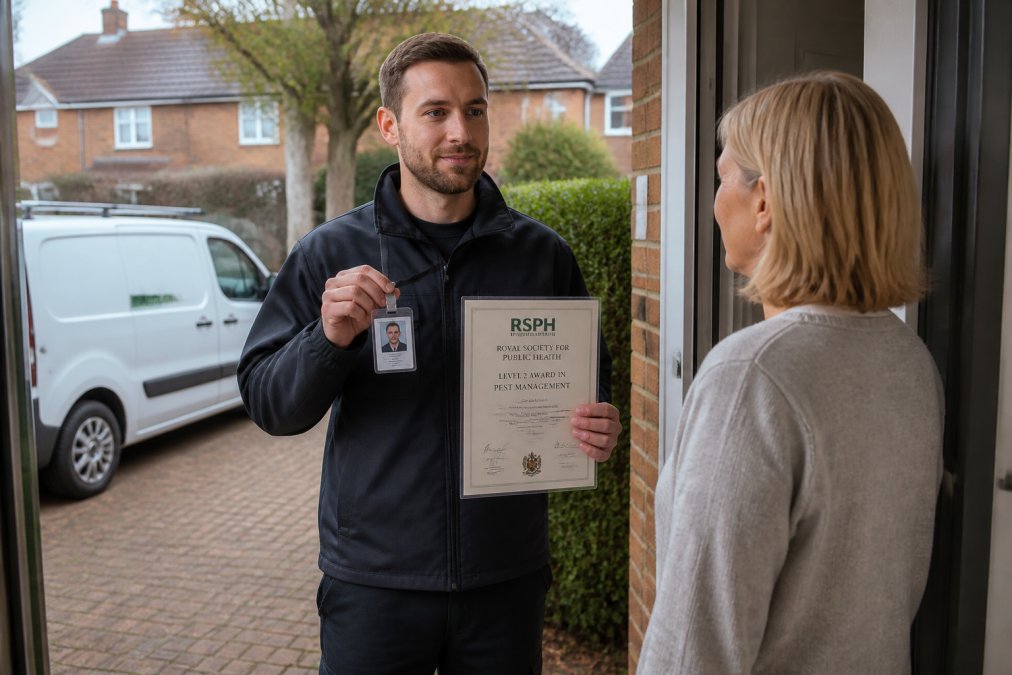
A practical checklist you can run through on the phone:
- Ask which qualification the attending technician holds and when it was obtained
- Ask whether the company is a member of a recognised trade association
- Request the public liability insurance certificate, or at least the insurer's name
- Confirm whether the technician is directly employed or subcontracted
- Ask what documentation you will receive after treatment
That last point matters more than people expect. A proper report should record the pest species identified, the treatment applied, the product used and any follow-up recommended. If a company cannot describe what its paperwork looks like, that is a warning sign.
What most guides miss is that you can verify membership independently rather than taking a logo at face value. Trade body directories are public, and a quick search confirms whether a business is listed. If a company claims an affiliation that does not appear in the directory, ask why.
Licensing, Insurance and the Rules Around Pesticide Use
There is no single pest control licence in the UK. Instead, the legal framework is built from pesticide regulation, health and safety law, and the requirements attached to specific products and professional schemes.
The core rules that govern anyone applying pesticides professionally:
- Only approved pesticides may be used, and strictly according to the product label
- Rodenticides used in and around buildings are restricted to professional use in many cases
- Technicians handling certain professional products are expected to hold relevant certification
- COSHH assessments and risk assessments must be in place for the work
- Records of pesticide use must be kept
The Health and Safety Executive guidance on pesticides sets out the duties that apply to anyone using pesticides at work, including the requirement to assess risk and control exposure.
Beyond the law, voluntary schemes signal a higher standard. BASIS PROMPT registration demonstrates that a technician keeps their pesticide knowledge current through structured CPD. NPTA membership indicates affiliation with the National Pest Technicians Association, another recognised trade body.
Insurance is the piece homeowners overlook most often. Public liability cover protects against damage to your property. Treatment insurance covers the cost of remedial work if a treatment fails or causes harm.
Why Qualifications Matter More Than a Quick Fix
Pest control qualifications are the difference between treating a symptom and solving a problem. An unqualified operator can kill the rats you can see. A qualified technician works out why they are there, where they are getting in and what will stop them returning.
That distinction shows up in the results. A common mistake is booking the cheapest quote for a one-off spray, then paying again three months later when the activity resumes. The infestation was never resolved, only interrupted.
What a properly qualified approach delivers:
- Correct species identification, which determines the entire treatment strategy
- Source tracing, so entry points and harbourage are addressed rather than ignored
- Proofing recommendations that reduce the chance of recurrence
- Safe product selection appropriate to your household, including pets and children
- Clear documentation you can hand to a tenant, insurer or environmental health officer
For landlords and hospitality operators, that documentation is not optional. Environmental health inspections, tenancy agreements and food hygiene standards all depend on being able to demonstrate that pest management is handled by competent people.
ProPest Oxford Ltd works on exactly this principle: identify the source of the infestation rather than just the symptoms. Every technician holds a minimum RSPH Level 2 qualification, the firm is associated with the NPTA and BASIS PROMPT, and it is fully insured. Appointments are available same-day or next-day, seven days a week, which matters when you are dealing with an active problem rather than a theoretical one.
Pest problems rarely wait for a convenient moment, and choosing the wrong operator usually means paying twice. ProPest Oxford Ltd sends RSPH Level 2 qualified technicians who trace infestations to their source, treat safely around families and pets, and document everything for landlords, insurers and environmental health. With same-day and next-day appointments across the week and full insurance in place, you get a resolution rather than a temporary pause. Get started with ProPest Oxford Ltd and put a properly qualified team on the problem.
Frequently Asked Questions
What qualifications do I need to be a pest control technician?
The industry standard is the RSPH Level 2 Award in Pest Management, which covers pest biology, safe pesticide handling and treatment methods. There is no single legal licence required to work as a technician, but employers and clients increasingly expect formal qualifications. Practical experience under supervision is also essential before working independently.
Are pest control technicians required to be certified?
There is no blanket legal requirement for pest control technicians to hold a specific certification in the UK. However, anyone applying professional pesticides must comply with COSHH regulations and product label instructions. Registration schemes such as BASIS PROMPT set voluntary standards that reputable firms follow. Hiring a technician with recognised pest control qualifications gives you stronger assurance of competence and safety.
What is the RSPH Level 2 Award in Pest Management?
The RSPH Level 2 Award in Pest Management is a nationally recognised qualification covering pest identification, biology, control methods and safe use of pesticides. It is widely regarded as the entry-level benchmark for professional technicians. The course typically involves both theory and practical assessment. Technicians holding this award have demonstrated foundational competence across common pests including rodents, insects and birds.
How do I check if a pest control company is professional and qualified?
Ask for the technician's RSPH Level 2 certificate or equivalent, and check whether the company is a member of a recognised trade body such as the NPTA. Verify insurance coverage and ask about ongoing training. You can also check BASIS PROMPT registration, which confirms the technician meets continuing professional development requirements. A reputable firm will happily provide this information before you book.
Do pest control technicians need a licence to use pesticides?
In the UK, technicians do not need a personal licence to apply pesticides, but they must follow strict rules. Professional users must comply with COSHH assessments, use approved products and hold relevant certificates of competence for certain application methods. Some pesticides are restricted to professional use only. Reputable companies ensure their technicians are trained and that all treatments meet legal and safety standards.
How can I verify pest control technician credentials before letting someone into my home?
Request the technician's qualification certificates, check the company's trade body membership and confirm they carry public liability insurance. BASIS PROMPT registration can be checked online. Ask whether the firm conducts DBS checks for staff entering homes. A professional company will provide these details without hesitation. If a provider is evasive about credentials, treat that as a warning sign and look elsewhere.