 ultimate-guide
Pest Prevention for Agricultural Buildings: A 2026 Guide
Table of Contents
- Why Pest Prevention for Agricultural Buildings Matters More Than Cure
- The Usual Suspects: Common Pests in Agricultural Buildings
- Rodent Proofing Agricultural Buildings: Where to Start
- Integrated Pest Management for Farms: A Practical Framework
- Pest Control Legislation for Agriculture: Your Legal Duties
- Actionable Prevention Steps for Stored Grain and Livestock Areas
- Monitoring and Maintenance: Keeping Your Pest Prevention Working
- Conclusion: Building a Pest-Resilient Farm
- Frequently Asked Questions
Last Updated: September 8, 2026
Why Pest Prevention for Agricultural Buildings Matters More Than Cure
A single rodent infestation can compromise an entire season of stored grain, damage structural integrity, and put livestock health at risk. The cost of reactive treatment almost always exceeds the cost of systematic prevention, which is why pest prevention for agricultural buildings has become a core part of modern farm management rather than an afterthought. This guide from ProPest Oxford Ltd walks through the practical steps every farm operator should take, from structural proofing to legal compliance.
The distinction matters because agricultural environments present unique challenges. Unlike a domestic kitchen, a farm building offers pests unlimited harbourage, consistent food sources, and complex access routes through cladding, roofing, and service entries. Prevention here means designing the building and its routines to make infestation structurally unlikely, not simply responding when signs appear.
The Usual Suspects: Common Pests in Agricultural Buildings
The most damaging pests in agricultural settings are rodents, particularly rats and mice, alongside stored product insects such as grain weevils and flour beetles. Birds, including pigeons and starlings, also cause significant problems through nesting material blocking ventilation and droppings contaminating feed.
Rats and mice are the primary concern for most farm buildings because they gnaw through cabling, insulation, and even concrete over time. Their presence near stored grain creates direct financial loss through consumption and contamination, while their droppings pose a real hygiene risk in livestock areas. Stored product insects multiply quickly in warm, undisturbed grain, and by the time they are visible, the infestation is often widespread.
Birds present a different challenge. Their nesting activity blocks gutters and ventilation systems, and their droppings are both corrosive to building materials and a vector for disease. Understanding which pests pose the greatest risk to your specific operation is the first step in building a targeted prevention plan, since the control measures for rodents differ substantially from those for flying insects or birds.
Rodent Proofing Agricultural Buildings: Where to Start
Rodent proofing agricultural buildings begins with a thorough external inspection to identify every potential entry point, then methodically sealing each one. Rats can squeeze through gaps of around 15 millimetres, while mice need barely 6 millimetres, so the standard for proofing must be exacting.
Start by walking the full perimeter of every building. Look for gaps around pipework and cable entries, damaged cladding, worn door seals, and openings where the structure meets the ground. Pay particular attention to corners where walls meet floors, as rodents exploit these junctions. Fill gaps with suitable materials such as wire mesh, expanding foam designed for pest exclusion, or cement for larger holes. Metal mesh should be galvanised to prevent corrosion in agricultural environments.
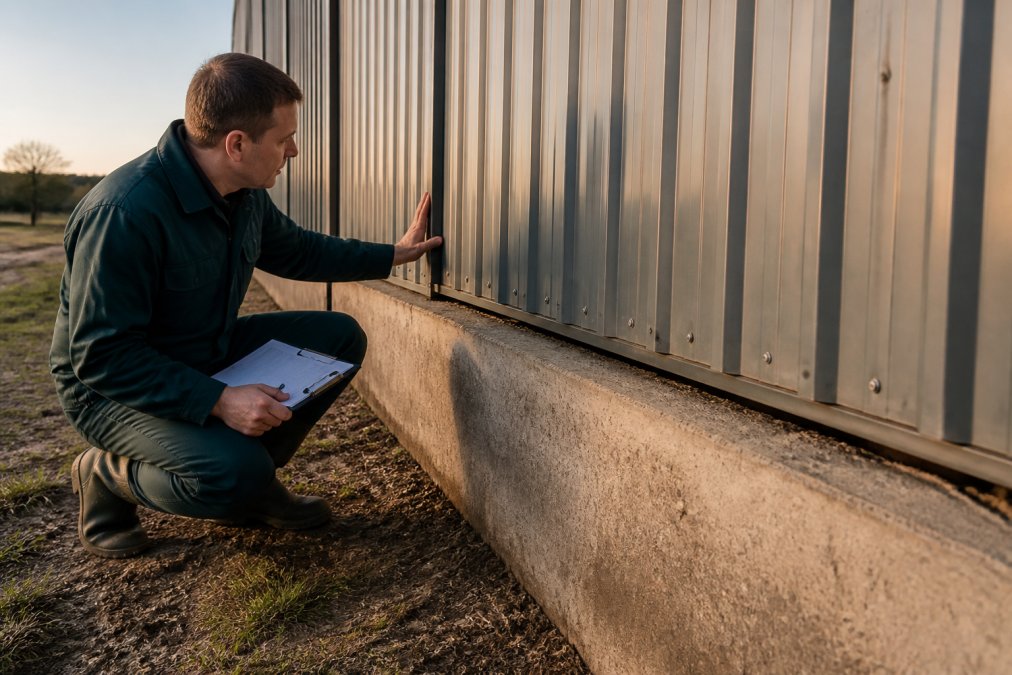
Doors are a frequent weak point. Fit brush strips to the base of personnel doors and ensure roller shutter doors close flush with the ground. Roof vents and ridge lines need fine mesh covering, since rodents readily climb walls and enter at high level. Drainage systems also require attention, as rats travel through sewer and drain networks and can enter buildings via damaged or unsealed drain access points.
Integrated Pest Management for Farms: A Practical Framework
Integrated pest management for farms is a systematic approach that combines prevention, monitoring, and targeted control rather than relying on routine pesticide application. The framework rests on four pillars: exclusion, hygiene, monitoring, and intervention.
Exclusion is the structural work covered above, keeping pests out in the first place. Hygiene means removing the conditions that attract them: spilled grain swept promptly, feed stored in sealed containers, and vegetation kept clear of building perimeters. Monitoring involves regular inspection and the use of detection tools such as bait stations and traps to establish whether pests are present and where activity is concentrated.
Intervention is the final stage, and it should be targeted based on what monitoring reveals. This might mean trapping in a specific area rather than broadcasting rodenticide across the whole site. The advantage of this framework is that it reduces chemical use, lowers costs, and is more sustainable over the long term. Farms adopting this structured approach typically find they catch problems early, when they are cheaper and easier to resolve.
| IPM Stage | Key Actions | Frequency |
|---|---|---|
| Exclusion | Seal entry points, fit door brushes, mesh vents | Annual audit plus repairs as found |
| Hygiene | Sweep spills, store feed sealed, clear perimeter vegetation | Daily routine |
| Monitoring | Inspect bait points, check for droppings and gnawing | Weekly to monthly |
| Intervention | Targeted trapping or treatment based on monitoring data | As required |
Pest Control Legislation for Agriculture: Your Legal Duties
Pest control legislation for agriculture in the UK places clear legal duties on farm operators, and ignorance of these requirements is not a defence. The Prevention of Damage by Pests Act 1949 requires occupiers of land and buildings to notify the local authority if rats or mice are present in numbers that could be considered an infestation.
Beyond this, the Control of Pesticides Regulations 1986 and subsequent legislation govern how professional pest control products are used. Anyone applying professional-use rodenticides must be competent and, in practice, this means holding recognised qualifications. The use of rodenticides is further regulated under the UK Rodenticide Stewardship Regime, which requires professional users to be trained and certified to minimise the risk to wildlife.
Food safety legislation also applies where produce is stored for human consumption. Farms supplying into the food chain must demonstrate due diligence in pest management, and guidance from the Food Standards Agency makes clear that effective pest control procedures are a prerequisite for compliance. This means keeping records of inspections, treatments, and proofing work. A documented pest management plan is evidence of your commitment to legal compliance and can be critical if an enforcement officer inspects your premises.
Actionable Prevention Steps for Stored Grain and Livestock Areas
Stored grain areas demand a different prevention approach to livestock housing, and each needs its own protocol. For grain, the priority is denying pests both moisture and undisturbed harbourage. Keep storage areas clean and free of spillage, and consider temperature monitoring since cooler grain is less hospitable to stored product insects. Regular turning of grain disrupts insect life cycles and should be part of the storage routine.
Livestock areas present a different challenge because feed and bedding provide constant attractions. Store feed in rodent-proof containers rather than open sacks, and clean up spilled feed promptly rather than leaving it for livestock to find later. Bedding should be stored clear of walls to reduce harbourage, and any dead stock or afterbirth removed immediately, as these attract flies and vermin.
A common mistake is focusing prevention only on the main storage building while ignoring ancillary structures. Implement the same proofing and hygiene standards across feed stores, machinery sheds, and even temporary field storage. Pests do not respect the distinction between a primary building and an outbuilding, and an untreated shed can become a reservoir that reinfests the main site.
Monitoring and Maintenance: Keeping Your Pest Prevention Working
Prevention efforts decay over time. Seals degrade, doors become damaged, and new gaps appear as buildings settle and weather. For this reason, pest prevention for agricultural buildings requires a scheduled monitoring and maintenance routine rather than a single proofing effort.
Establish a network of monitoring points around each building. External bait stations should be checked regularly, with any activity recorded and dated. Internal inspections should look for fresh droppings, gnaw marks, and rub marks along walls, all of which indicate active rodent movement. Keep a log of these checks, as the data helps identify patterns and proves due diligence.
Schedule a full structural review at least annually, walking the perimeter of every building to identify new entry points. Repair any damage promptly, since a small gap left open for a season will be found and exploited. The Agriculture and Horticulture Development Board publishes practical resources on building maintenance and biosecurity that are useful references for structuring these reviews. Farms that maintain this discipline consistently report fewer infestations and lower control costs over time.
Conclusion: Building a Pest-Resilient Farm
Pest prevention for agricultural buildings is not a single project but an ongoing commitment to structural integrity, hygiene, and vigilance. The farms that succeed are those that integrate prevention into their daily routines, monitor consistently, and act on the evidence their monitoring reveals. The legal duties are clear, and the practical benefits, in terms of protected grain, healthier livestock, and lower control costs, justify the investment.
When infestations do take hold, or when you need expert guidance on proofing and prevention, professional support makes the difference. ProPest Oxford Ltd provides rapid response and long-term prevention across Oxfordshire and East Sussex, with technicians holding a minimum RSPH Level 2 qualification and services available seven days a week. Their focus on identifying the source of an infestation rather than treating only the symptoms aligns with the preventative philosophy outlined here.
Book a service with ProPest Oxford Ltd and protect your agricultural buildings from the persistent threat of pests.
Frequently Asked Questions
What are the most common pests found in agricultural buildings?
Rats and mice are the most frequent problem in agricultural buildings, drawn by food stores and harbourage. Brown rats often burrow near foundations, while house mice thrive indoors. Birds, particularly pigeons and starlings, can roost in roof spaces, and insects such as flour beetles and grain weevils attack stored produce. Each pest type needs a different approach, which is why identifying the species is the first step in any pest prevention plan.
What are the legal requirements for pest control in food-producing agricultural buildings?
If you produce, store or process food for sale, you must comply with retained Regulation (EC) No 852/2004 on food hygiene. This requires adequate pest control procedures to prevent contamination. Your local authority or the Food Standards Agency can inspect your premises, and failure to control pests can lead to enforcement action. Keeping records of monitoring and treatment is essential to demonstrate compliance. For non-food agricultural buildings, you still owe a duty of care under the Prevention of Damage by Pests Act 1949.
How does integrated pest management for farms actually work?
Integrated pest management (IPM) is a four-stage approach rather than a single treatment. First, you monitor regularly to identify pests and their activity levels. Second, you use prevention measures like proofing and good hygiene. Third, you intervene with physical or biological controls, such as traps or natural predators. Fourth, you apply targeted pesticide treatments only when thresholds are exceeded. This framework reduces chemical use, lowers costs and delivers longer-lasting control than reactive spraying alone.
How can I proof my farm buildings against rodents?
Start by inspecting the building exterior at ground level. Brown rats can squeeze through gaps of 15 mm, while mice need only 6 mm. Seal holes around pipework and door bases with wire mesh and cement. Fit brush strips to doors and keep them closed when not in use. Check roof junctions and vents, as rodents climb well. Maintain a 1 m clear zone around the building perimeter so rats cannot approach under cover. Proofing works best alongside trapping to deal with rodents already inside.
How quickly should I act if I spot signs of pests in an agricultural building?
Act the same day you notice droppings, gnaw marks or nesting material. A small mouse problem can become a full infestation within weeks, as one pair breeds up to eight litters a year. In livestock buildings, rodents stress animals and spread disease. In grain stores, insects multiply rapidly and can ruin an entire batch. Early intervention with traps and proofing repairs is far cheaper than fumigating a contaminated store or replacing spoiled feed.
Are there environmentally friendly pest control methods for farms?
Yes. The foundation is good hygiene: store grain in sealed containers, clean up spillages promptly and remove standing water. Proofing blocks entry routes without chemicals. For rodents, break-back traps and electronic devices offer humane, targeted control. Biological controls include encouraging barn owls by installing nest boxes; one owl can take over 1,000 rodents a year. When pesticides are necessary, choose low-toxicity options and apply them as spot treatments rather than blanket sprays.