 how-to
How to Seal Gaps to Keep Mice Out: A Step-by-Step Guide
Table of Contents
- Why Sealing Gaps Is the Only Permanent Fix for Mice
- How to Find Mouse Entry Points Around Your Property
- What You'll Need: Tools and Materials Checklist
- The Best Materials to Seal Mouse Holes
- Step-by-Step: How to Seal Holes Around Pipes to Stop Mice
- Sealing Large Holes Against Mice: Gaps Bigger Than Your Fist
- Common Mistakes to Avoid When Sealing Gaps
- When DIY Sealing Isn't Enough: Calling in a Professional
- Frequently Asked Questions
Last Updated: October 21, 2026
Why Sealing Gaps Is the Only Permanent Fix for Mice
Mice don't need a door left open. A gap the width of a pencil is enough for a house mouse to squeeze through, and that single fact explains why trapping alone never solves the problem. If you want to know how to seal gaps to keep mice out, you have to accept one uncomfortable truth first: every trap you set is treating a symptom.
At ProPest Oxford Ltd, we see the same pattern on repeat. A homeowner catches three mice, breathes a sigh of relief, and then hears scratching in the loft again six weeks later. The mice weren't clever. They simply walked back in through the same hole.
Sealing gaps is the practice of closing every opening a mouse can physically pass through, using materials it cannot chew or push aside. It works because it removes access, not just the animals currently inside.
The UK government guidance on rodent control is clear that proofing a building is a core part of managing infestations, not an optional extra. Traps and bait reduce numbers. Sealing stops the next wave.
Below, we'll show you exactly how to find the gaps, which materials actually hold up, and how to fix the tricky spots around pipes and large holes.
How to Find Mouse Entry Points Around Your Property
Finding entry points is a matter of looking low, looking close, and knowing what mouse evidence looks like. Mice travel along walls and skirting boards, so that's where you start.
Work around each room at floor level with a torch. Check these spots:
- Behind kitchen units and under sinks, where pipes pass through walls
- Air bricks and vents, especially older ones with broken grilles
- Where pipes and cables enter the building from outside
- Loft eaves and roof spaces, a favourite route in colder months
- Garage and outbuilding walls, particularly at the base
- Doors, including the gap under external doors and around frames
Look for the tell-tale signs: dark greasy smears along walls, droppings the size of a grain of rice, shredded nesting material, and small holes with worn edges.
A common mistake is checking only at eye level. Get on your hands and knees. The gap you're hunting is often no wider than a fingernail, and it will be tucked behind something.
What You'll Need: Tools and Materials Checklist
You don't need a specialist kit to seal gaps, but you do need the right materials. Here's what we'd have on hand before starting.
- Wire wool (coarse grade) for packing around pipes and cables
- Expanding foam for filling larger voids
- Silicone sealant and a sealant gun for narrow gaps and cracks
- Mortar or cement for brickwork and masonry holes
- Metal mesh or perforated plate for vents and large openings
- Copper mesh as a chew-proof alternative to wire wool
- A torch for inspecting dark corners
- A scraper and a dustpan for clearing debris
- Protective gloves and a dust mask
- A tube of rodent-proof sealant for irregular gaps
Buy more wire wool than you think you need. It's cheap, and running out halfway through a job means another trip to the shop while a hole sits open.
The Best Materials to Seal Mouse Holes
The best materials to seal mouse holes are those a mouse cannot chew through, push aside, or squeeze past. Mice gnaw constantly, so soft fillers alone rarely hold up.
Here's how the main options compare:
| Material | Best For | Chew-Proof? | Notes |
|---|---|---|---|
| Wire wool + sealant | Gaps around pipes and cables | Yes, when packed tight | Mice can't chew steel wool |
| Copper mesh | Vents and larger openings | Yes | Lasts longer than wire wool outdoors |
| Expanding foam | Large voids | No, on its own | Must be combined with wire wool |
| Silicone sealant | Narrow cracks | Partly | Fine for hairline gaps |
| Mortar or cement | Brick and masonry | Yes | Best for structural holes |
| Metal mesh plate | Air bricks and vents | Yes | Fix securely at the edges |
The rule we follow: anything soft needs a hard layer behind it. Expanding foam on its own is a mouse highway, not a barrier. Pack wire wool in first, then foam over it.
Materials That Fail and Why
Some materials feel like they should work but don't. Steel wool pads from the kitchen are a false economy. They rust, crumble, and mice push straight through the gaps that form.
Plastic mesh is another weak choice. A determined mouse will chew through it in a single night. Cardboard, cloth, and paper are nesting material, not sealant.
The most common failure is expanding foam used alone. It looks solid, but mice tunnel through it with ease. Always pair it with a chew-proof core.
Step-by-Step: How to Seal Holes Around Pipes to Stop Mice
Sealing holes around pipes comes down to one principle: fill the gap with something hard and tight, then cover it. Here's the method we use.
- Clean the gap. Remove dust, old sealant, and debris so new materials bond properly.
- Pack wire wool tightly around the pipe, pushing it into the gap with a screwdriver until it's firm.
- Check for movement. The wool should not shift when you press it.
- Seal over the top with silicone or a suitable filler to lock it in place and block draughts.
- Repeat from both sides where possible, inside and out.
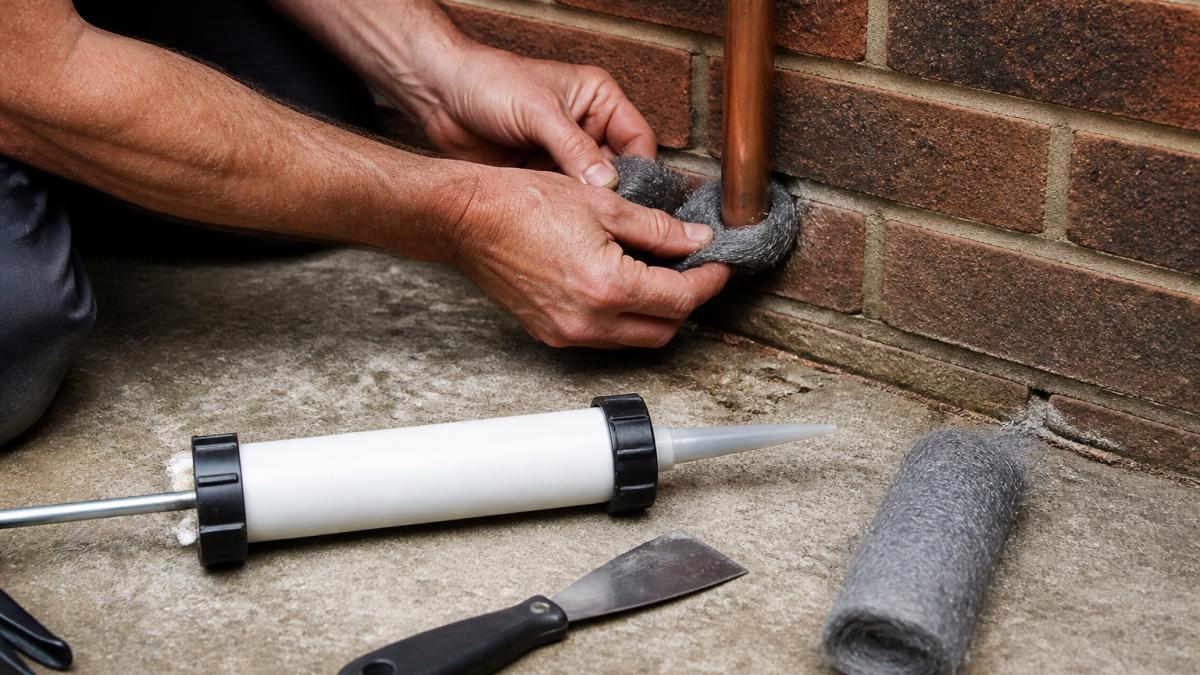
The key is density. Loose wire wool leaves gaps. Packed tight, it becomes a wall a mouse cannot pass. This single step solves a huge share of pipe-related entry points.
Sealing Large Holes Against Mice: Gaps Bigger Than Your Fist
Sealing large holes against mice needs a layered approach, because a big opening is an invitation for more than one animal. You can't just fill it with foam.
Start with a rigid backing. Push metal mesh or a piece of perforated plate into the opening and fix it at the edges. Then pack wire wool around the edges where it meets the wall. Finish with mortar or expanding foam over the mesh to close the void.
For holes in brickwork, mortar alone is often enough once the edges are clean. For holes around pipes in a large opening, combine mesh, wire wool, and sealant in that order.
Don't forget the outside. A large gap at ground level is the easiest route in, and it's the one most people miss because it's hidden behind a bin or a plant pot.
Common Mistakes to Avoid When Sealing Gaps
The most common sealing mistakes all share one cause: treating the job as a quick fix rather than a proper repair. Here's what to watch for.
- Sealing only the inside. Mice will keep trying from outside. Seal both faces where you can.
- Leaving one gap open. A single missed hole undoes the rest of the work.
- Using soft materials alone. Foam and plastic fail fast against gnawing.
- Ignoring the loft and roof. Many infestations start from above.
- Not checking drains and vents. These are classic routes that get overlooked.
- Sealing before clearing the infestation. If mice are still inside, seal exits last so you don't trap them in.
That last point matters. If you seal every hole while mice are still active indoors, you can trap them in wall cavities, which makes the problem harder and smellier to solve.
When DIY Sealing Isn't Enough: Calling in a Professional
DIY sealing handles most domestic gaps well, but some situations call for a professional. If mice keep returning despite your efforts, the entry points are likely hidden or the infestation is established.
Signs it's time to call in help:
- Scratching or droppings continue after sealing
- You find gaps in hard-to-reach areas like roof voids or under floors
- The problem affects a rental property or business premises
- You need proof of professional treatment for hygiene or insurance reasons
Professional pest control focuses on finding the source, not just the symptoms. At ProPest Oxford Ltd, our technicians hold a minimum RSPH Level 2 qualification, and we're associated with NPTA and BASIS PROMPT. We offer same-day or next-day appointments and work seven days a week, so a gap doesn't stay open while you wait.
For landlords and business owners, a scheduled prevention visit keeps entry points sealed before they become a problem. That's the difference between reacting to mice and stopping them.
Frequently Asked Questions
How small a gap can a mouse squeeze through?
A house mouse can pass through a gap as narrow as 6mm, roughly the width of a pencil. Young mice need even less. This is why sealing gaps to keep mice out means checking every crack, not just the obvious holes. Pay particular attention to gaps under doors, around pipework, and where brickwork meets timber. If you can fit a pencil into a gap, a mouse can use it, so fill it with wire wool and sealant before the problem grows.
Can mice chew through expanding foam or caulk?
Yes. Mice gnaw through expanding foam, silicone caulk, and plastic mesh with little effort. These materials slow them down but do not stop them. The best materials to seal mouse holes combine something mice cannot chew, such as wire wool or galvanised steel mesh, with a sealant that holds it in place. Pack the gap tightly with wire wool first, then cover it with a hard-setting filler or mortar so the mouse meets resistance at every layer.
Should you use steel wool or wire mesh to block mice?
Both work well, and the choice depends on the gap. Wire wool is ideal for irregular cracks and gaps around pipes because it compresses into shape. Galvanised steel mesh suits larger openings, vents, and air bricks, where it can be cut to size and fixed securely. Avoid ordinary steel wool that rusts quickly outdoors; use stainless or copper wire wool instead. Whichever you choose, pack it tightly so there are no loose edges a mouse can pull at.
What should you do if mice keep getting in after sealing gaps?
If mice return after you seal gaps, you have missed an entry point. Mice often use routes behind kitchen units, under floors, and through shared walls or drainage runs that are hard to see. A professional survey uses tracking dust, inspection cameras, and knowledge of typical mouse routes to find what DIY checks miss. Sealing is only permanent once every entry point is found, so a follow-up inspection is worth arranging if activity continues.
Mice will always look for the easiest way in, and a single missed gap is all it takes. If you've sealed what you can see but the scratching continues, the source is probably somewhere you haven't looked. Get in touch with ProPest Oxford Ltd to book a survey, and our qualified technicians will find the entry points, seal them properly, and help you keep mice out for good.