 ultimate-guide
School Pest Control Policies and Safety: A 2026 Guide
Table of Contents
- What Every School Pest Control Policy Must Cover
- Integrated Pest Management in Schools: Prevention Before Pesticide
- How to Complete a School Pest Control Risk Assessment
- Keeping Pupils Safe During and After Pest Treatments
- Pesticide Safety in Schools: Storage, Application and Notification
- Why Your School Pest Control Log Matters (and What to Record)
- Conclusion
- Frequently Asked Questions
Last Updated: 8 October 2026
What Every School Pest Control Policy Must Cover
A school pest control policy is a written framework that sets out how a school prevents, monitors and responds to pest activity while protecting pupils, staff and visitors. In practice, it should name who is responsible, how risks are assessed, which control methods are permitted, and how parents and staff are notified before and after any treatment.
At ProPest Oxford Ltd, we work with schools across Oxfordshire and East Sussex, and the same gaps appear again and again. Policies tend to be either a single paragraph copied from a template or a folder nobody has opened since it was signed. Neither survives contact with an actual infestation.
A workable school pest control policies and safety framework covers five things: a named coordinator, a current site risk assessment, a prevention-first approach, clear rules on pesticide use, and a written record of every inspection and treatment. Miss any one of those and the policy becomes paperwork rather than protection.
Roles and Responsibilities Under the Policy
Someone has to own this. A common mistake is treating pest control as the caretaker's problem until it becomes the headteacher's emergency.
- Headteacher or principal: approves the policy and signs off any pesticide use on site
- Site manager or facilities lead: runs day-to-day monitoring and books contractors
- Pest control coordinator: keeps the log, reports sightings, liaises with the contractor
- Contractor: holds the relevant RSPH or BASIS PROMPT credentials and provides written reports
- All staff: report sightings the same day rather than mentioning it at the end of term
The coordinator role is the one schools most often leave blank. Without it, sightings get lost and small problems become structural ones.
Integrated Pest Management in Schools: Prevention Before Pesticide
Integrated pest management in schools is a tiered approach that starts with excluding pests and removing what attracts them, and only reaches for chemicals when those measures have failed. It is the standard approach recommended by public health bodies because it reduces pesticide exposure for children while still solving the problem.
The hierarchy runs in this order:
- Exclusion: seal gaps around pipework, repair damaged air bricks, fit door brushes and screens
- Sanitation: fix leaks, clear food waste promptly, store dry goods in sealed containers
- Monitoring: routine inspections of kitchens, bin stores, plant rooms and roof voids
- Non-chemical control: traps, proofing, habitat removal
- Targeted pesticide: only where the above have not worked, applied by a qualified technician
For schools, that order is not optional. It is the difference between a policy that satisfies insurers and one that satisfies parents.
How to Complete a School Pest Control Risk Assessment
A school pest control risk assessment is a documented review of where pests could enter, what would attract them, and who could be harmed by an infestation or a treatment. It should be reviewed at least annually and updated whenever the site changes.
Work through the site room by room and record findings honestly:
- Kitchens and dining halls: food storage, waste routes, drain condition, proofing gaps
- Bin stores: lid condition, distance from buildings, cleaning frequency
- Plant rooms and roof voids: access points, nesting evidence, insulation damage
- Classrooms and stores: food used in lessons, art supplies, textiles
- Outdoor areas: standing water, litter, overgrown boundaries, compost
Record the likelihood and the potential impact for each finding, then set an action with a deadline and a named owner. A finding without an owner is not a risk assessment, it is a list.
Keeping Pupils Safe During and After Pest Treatments
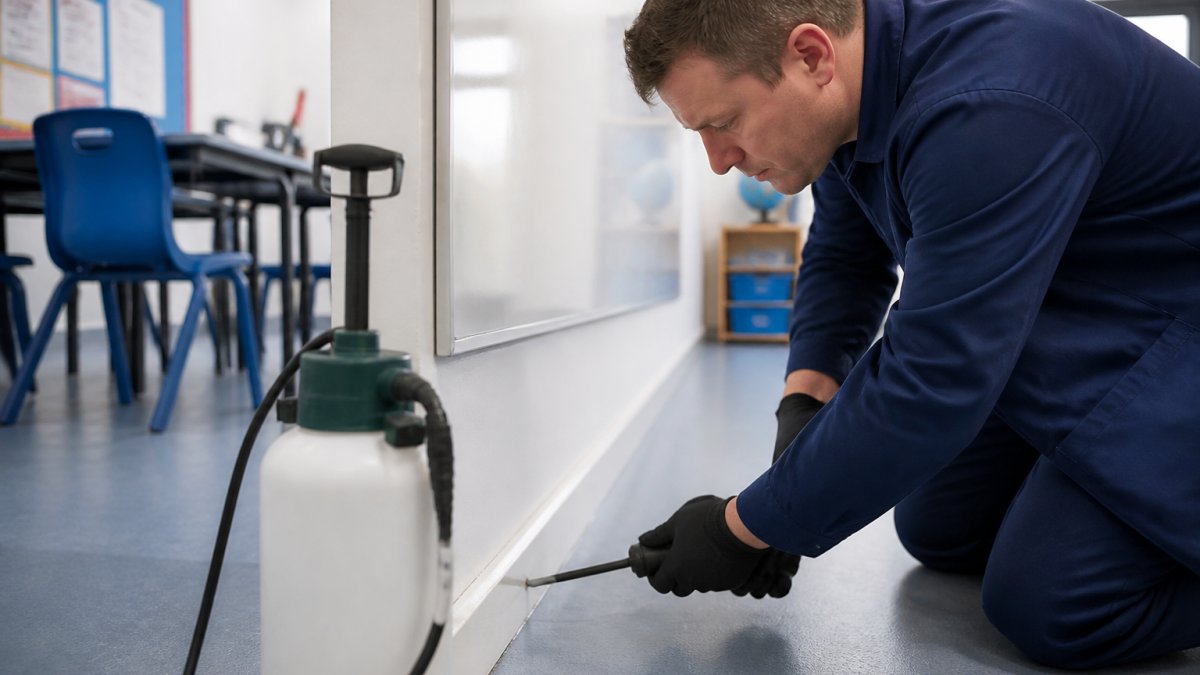
Pupil safety during treatment depends on three things: correct product choice, restricted access to treated areas, and clear communication with staff and parents. Most incidents we see are not caused by the pesticide itself but by someone entering a treated room before it has been cleared for use.
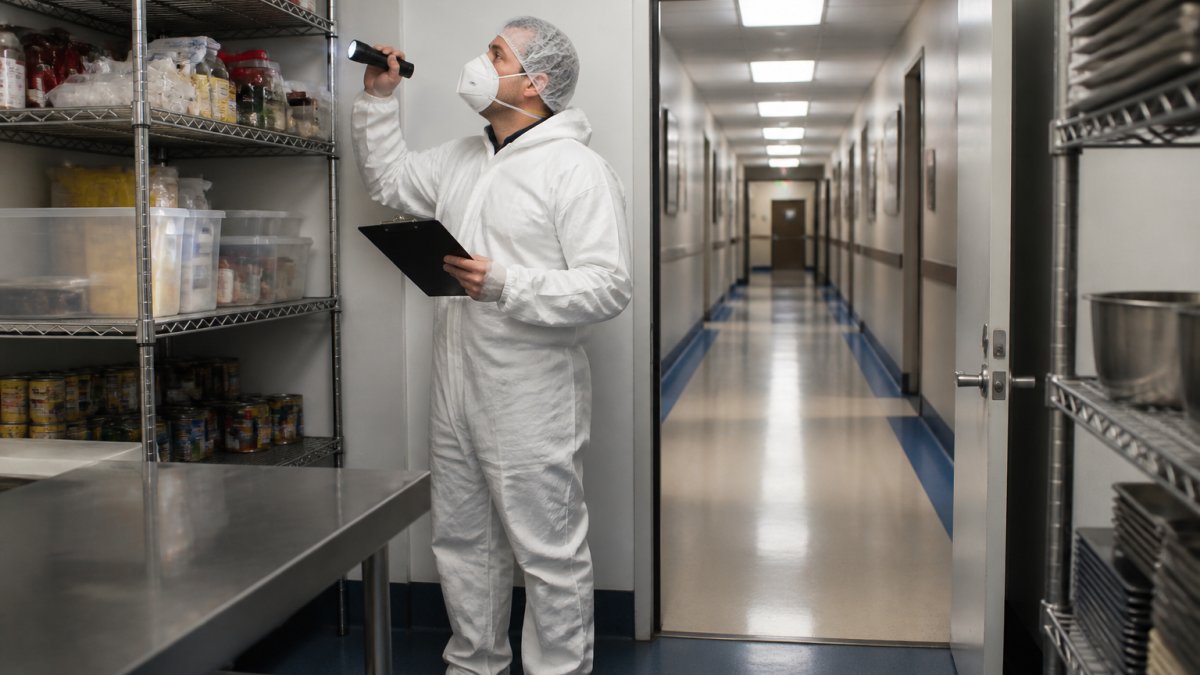
Where possible, treatments should be scheduled outside teaching hours or during holidays. If that is not possible, the treated area should be closed, and re-entry should only happen once the technician confirms it is safe. Staff should know which rooms are affected, when they can be reopened, and who to contact if they have concerns.
Pesticide Safety in Schools: Storage, Application and Notification
Pesticide safety in schools means restricting who can apply products, where they are stored, and how the school communicates with parents and staff. Under UK law, anyone applying pesticides as a professional service must be trained and certified, and products must be used in line with their approved label.
In practice, that means:
- Storage: products kept locked, away from food and pupil areas, with safety data sheets on file
- Application: carried out by qualified technicians, never by general staff
- Notification: parents and staff informed in advance where a treatment is planned, and told what to expect afterwards
- Record keeping: every product, quantity, location and date logged
Schools should also check that their contractor holds current certification and public liability insurance. Health and Safety Executive guidance on pesticides sets out the employer's duties around safe use and storage on site.
Why Your School Pest Control Log Matters (and What to Record)
A school pest control log is the single most useful document in the whole policy. It is what proves the school acted, and it is what an environmental health officer or insurer will ask for first.
Record the following for every visit, whether it is a routine inspection or a call-out:
| Entry | What to record | Why it matters |
|---|---|---|
| Date and time | Visit date, arrival and departure | Proves monitoring frequency |
| Area inspected | Room, building, external zone | Shows coverage across site |
| Findings | Species, evidence type, location | Tracks whether a problem is recurring |
| Action taken | Treatment, proofing, monitoring | Documents the response |
| Product used | Name, quantity, application method | Required for safety records |
| Re-entry time | When the area is safe to use | Protects pupils and staff |
| Follow-up | Next visit date, outstanding actions | Closes the loop |
A log kept in a folder in the office is better than nothing. A log kept digitally with photos attached is what actually protects the school.
Conclusion
Keeping a school pest-free is not about reacting fast when something appears. It is about having a policy that names who does what, a risk assessment that reflects the real site, and a log that proves the work happened.
That is where we come in. ProPest Oxford Ltd provides school pest control across Oxfordshire and East Sussex, with technicians holding a minimum RSPH Level 2 qualification, appointments available seven days a week, and a focus on finding the source of an infestation rather than just treating the symptoms. We are NPTA members and BASIS PROMPT registered, fully insured, and used to working discreetly around term times and school hours.
If your policy has not been reviewed this year, or you need a contractor who will document every visit properly, book a service with ProPest Oxford Ltd and get a site assessment in place before the next term starts.
Frequently Asked Questions
What should a school pest control policy include?
A workable policy names who is responsible for reporting and coordinating pest control, sets out a prevention routine such as waste management and proofing, and explains how sightings are recorded. It should also cover how a school pest control risk assessment is completed before any treatment, what pesticide safety in schools requires, and how the school pest control log is maintained. Review it at least once a year and after any significant infestation.
How can schools prevent pests without using pesticides?
Most prevention is about removing food, water and shelter. Fix leaking pipes and dripping taps, store food in sealed containers, keep bins lidded and emptied daily, and seal gaps around pipework and external doors. Report sightings early rather than waiting for a scheduled visit. This approach sits at the heart of integrated pest management in schools and often removes the need for chemical treatment altogether.
What is integrated pest management in schools?
Integrated pest management, usually shortened to IPM, means dealing with the conditions that attract pests before reaching for pesticides. It starts with inspection and monitoring, moves to proofing and hygiene improvements, and uses chemical treatment only where non-chemical methods have not worked. In a school setting, IPM reduces the amount of pesticide used on site, which matters when buildings are occupied by children five days a week.
Who should be told when pest activity is found at school?
The person named in the policy as responsible for pest control should be told first, and they should record the sighting in the school pest control log with the date, location and what was seen. The headteacher or site manager should be informed, and the pest control contractor needs the detail to plan a visit. If treatment is required, parents and staff should be notified in advance, following the school's usual communication channels.
How long should pupils stay out of a treated area?
The re-entry time depends on the product used and the area treated, so it should always be confirmed by the contractor and recorded alongside the treatment details. Many treatments allow normal use once surfaces are dry, while others require the area to stay closed for longer. Pupils should not return until the contractor confirms the space is safe, and the school pest control log should note the exact time the area was cleared for use.
What records should a school keep about pest control?
Keep a single school pest control log covering every sighting, visit, treatment and follow-up. Record dates, locations, the pest identified, the product used where relevant, the contractor's name and any re-entry instructions. Store it with the school pest control risk assessment so the two documents can be read together. This record supports safeguarding, shows evidence of action during inspections, and makes it easier to spot repeat problems.
How often should a school review its pest management policy?
An annual review suits most schools, timed before the warmer months when rodent and insect activity increases. Review it sooner if the school has had an infestation, if the building layout changes, or if a new contractor takes over. Each review should check whether the school pest control risk assessment still reflects the site and whether the log shows problems recurring in the same areas.