 how-to
How to Clean Mouse Droppings Safely: A Step-by-Step Guide
Table of Contents
- Before You Start: What You'll Need to Clean Mouse Droppings Safely
- Step 1: Ventilate the Room and Keep Others Out
- What to Wear When Cleaning Mouse Droppings
- Can You Vacuum Mouse Droppings? Why Sweeping and Vacuuming Spread Risk
- Step 2: Disinfect Hard Surfaces, Worktops and Floors
- How to Clean Mouse Droppings from Carpet and Soft Furnishings
- When to Call Pest Control for Mice
- Frequently Asked Questions
Last Updated: 20 October 2026
Before You Start: What You'll Need to Clean Mouse Droppings Safely
Cleaning mouse droppings safely means never letting them dry out and become airborne. Fresh droppings carry the highest risk, and disturbing them with a broom or vacuum sends contaminated dust into the air you breathe.
Mice can spread bacteria and viruses through their urine, droppings and saliva. The main concern in UK homes is leptospirosis and salmonella, both spread when contaminated dust or water meets your mouth, nose or a cut. You do not need to panic. You do need to slow down and follow a proper sequence.
Gather these before you touch anything:
- Disposable nitrile gloves
- A face mask rated FFP2 or FFP3
- Safety glasses or goggles
- Paper towels and heavy-duty bin bags
- A disinfectant that kills bacteria and viruses
- A spray bottle of water and washing-up liquid
- Rubber gloves for the sink afterwards
Step 1: Ventilate the Room and Keep Others Out
Ventilation is the first action, not an afterthought. Open windows and doors to the outside for at least 15 minutes before you start. This dilutes any airborne particles already in the room.
Then clear the space. Keep children, pets and anyone pregnant or immunosuppressed well away until you have finished and disinfected. Close internal doors so dust cannot drift into other rooms.
Turn off fans, extractors and air conditioning while you work. Moving air lifts particles off surfaces and spreads them further.
A common mistake is cleaning a shed or loft with the door shut. Confined spaces hold contaminated dust for hours. Open everything you can, and if the space has no outside ventilation, wear your mask for the entire job, not just part of it.
Once the room is aired and empty, put on your gloves, mask and glasses before you go back in. Do not carry clean equipment into the room until you are dressed for the task.
What to Wear When Cleaning Mouse Droppings
Wear disposable nitrile gloves, an FFP2 or FFP3 face mask, and safety glasses every time you clean mouse droppings. Add a disposable apron or overalls if droppings are heavy or the area is hard to reach.
The mask is the piece most people skip, and it matters most. Droppings release fine particles when disturbed, and those particles travel straight to your lungs. A cloth face covering is not enough. Use a proper respirator that seals against your face.
Gloves protect your hands from contaminated surfaces and stop you transferring germs to your face. Change them if they tear, and never eat, drink or smoke during the job.
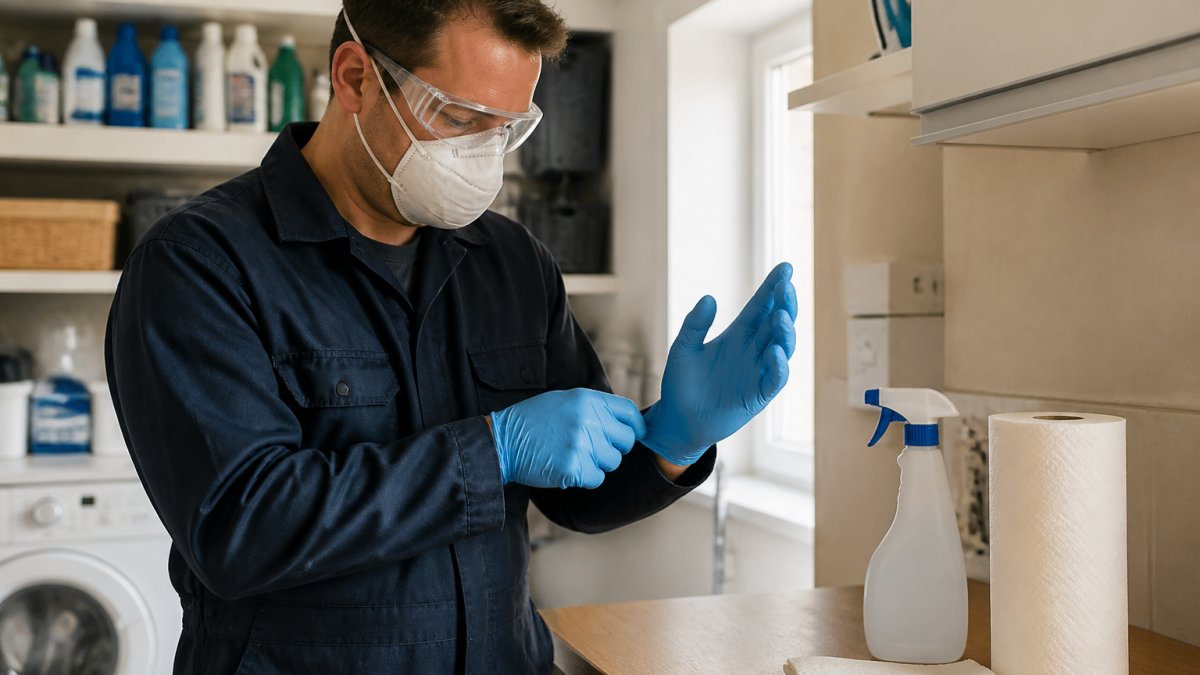
When you finish, remove gloves and mask last, turning them inside out as you go. Put everything straight into a sealed bag. Wash your hands with soap and warm water for at least 20 seconds, then wash again.
Can You Vacuum Mouse Droppings? Why Sweeping and Vacuuming Spread Risk
No. You should not vacuum mouse droppings, and you should not sweep them either. Both methods launch contaminated dust into the air and push it deeper into the room. A standard vacuum then blows that dust back out through its exhaust.
This is the point most guides get wrong. The danger is not the dropping itself. It is the fine dust it becomes when disturbed. Wetting the area first keeps that dust down.
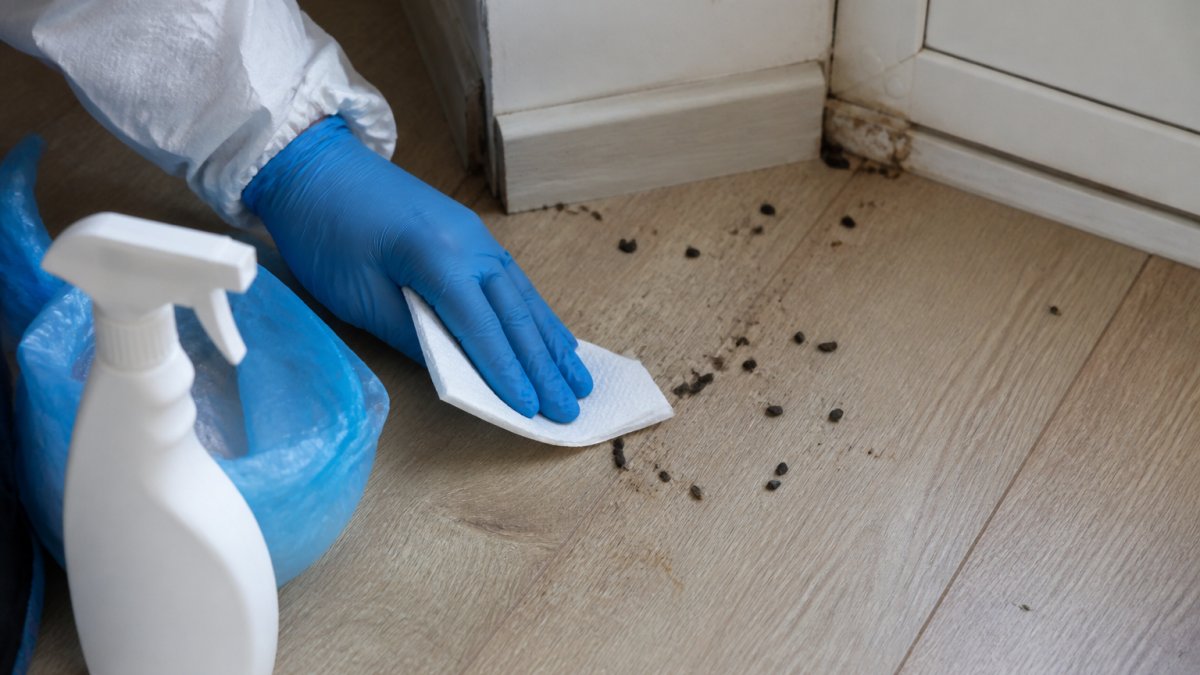
If droppings are on a hard floor, spray them with your water and washing-up liquid mix until damp. Wait a few minutes, then wipe up with paper towels and bin them in a sealed bag. Disinfect the surface afterwards.
For carpets, do not vacuum until the area has been cleaned and disinfected and has fully dried. Even then, use a vacuum with a sealed HEPA filter, and wear your mask while doing it. If the infestation is heavy, replace the carpet rather than clean it.
Step 2: Disinfect Hard Surfaces, Worktops and Floors
Spray, wait, then wipe. That order matters more than the product you choose. Disinfectants need contact time to work, so read the label and let it sit for the stated minutes before wiping.
Work from the cleanest area towards the dirtiest, so you do not spread contamination back over surfaces you have already done. Use fresh paper towels as you move, and bin them as you go.
Pay attention to the spots people forget:
- Behind and under appliances
- Inside cupboards and drawers
- Skirting board edges and corners
- Worktop joints and gaps
- Handles, taps and light switches
Mice travel along walls, so the edges of a room often carry the most droppings. Check along every wall, not just the open floor.
After disinfecting, wash any utensils, crockery or food-contact surfaces that may have been exposed. Bin any food that mice could have reached. Do not try to salvage it.
How to Clean Mouse Droppings from Carpet and Soft Furnishings
Cleaning mouse droppings from carpet needs a gentler approach than hard floors. You cannot scrub a carpet without pushing contamination deeper into the fibres. Wet the droppings first with your spray mix, then blot them up with paper towels.
Do not rub. Blot, lift, and bin the towels. Repeat until nothing transfers onto a clean towel.
Then treat the area with a disinfectant suitable for fabrics, following the label. Test it on a hidden patch first, because some products lift dye. Let the carpet dry fully with the windows open.
For soft furnishings, check cushions, bedding and stored fabrics for droppings and gnaw marks. Wash what you can on a hot cycle. Bin anything heavily soiled rather than washing it.
If mice have nested in a sofa, mattress or stored bedding, cleaning the surface is not enough. The nesting material itself is contaminated. In that case, removing the item is the safer choice, and we would always recommend it over a deep clean.
When to Call Pest Control for Mice
Call pest control when you find fresh droppings after cleaning, hear scratching in walls or ceilings, or see gnaw marks on wiring or food packaging. Cleaning removes the mess. It does not remove the mice.
Signs you need professional help:
- New droppings within days of cleaning
- Scratching or scurrying sounds, especially at night
- Gnawed cables, pipes or food packets
- A greasy smudge trail along walls
- More than one room affected
- Mice in a rental property or food business
Mice breed quickly, and a small problem becomes a large one fast. DIY traps can work for a single mouse, but they rarely solve an established infestation. The source is usually a gap you cannot see, and that is where professional work pays off.
Our technicians hold a minimum RSPH Level 2 qualification, and we focus on finding the source of the infestation rather than just the symptoms. We are associated with NPTA and BASIS PROMPT, fully insured, and available seven days a week with same-day or next-day appointments.
For landlords and business owners, discreet, scheduled visits can keep tenants and staff undisturbed. If you want the official guidance on rodent control and hygiene, the UK Health Security Agency guidance on pest control and the Health and Safety Executive advice on workplace hygiene are both worth reading.
Cleaning mouse droppings is a job you can do safely, but only if you slow down, ventilate, and never sweep or vacuum dry droppings. If the signs keep coming back, the mice are still there, and cleaning will not fix that.
ProPest Oxford Ltd can identify the source, remove the infestation and help stop it returning. Our RSPH Level 2 qualified technicians offer same-day or next-day appointments, seven days a week, with a focus on long-term prevention.
Get started with ProPest Oxford Ltd and book a service today.
Frequently Asked Questions
How do you safely clean up mouse droppings?
Never sweep or vacuum them dry. Open windows for at least 30 minutes, put on disposable gloves, a face mask and eye protection, then spray the droppings with a disinfectant until soaked. Leave it to sit for five minutes, wipe up with paper towels, and place everything in a sealed double bag. Clean the surface again with disinfectant, then wash your hands with soap and warm water. If the infestation is widespread, call a qualified pest controller to deal with the source.
What disinfectant should you use on mouse droppings?
A household disinfectant that carries a general-purpose virucidal and bactericidal claim is suitable for most hard surfaces. Mix it to the strength on the label and leave it in contact with the droppings for the full contact time stated, usually around five minutes. For carpets and soft furnishings, use a disinfectant spray labelled for fabrics rather than soaking them. Bleach solutions work on hard floors but will damage many worktops and upholstery, so check the surface first.
What should you do if you find a large amount of mouse droppings?
A large accumulation, especially in a loft, wall cavity or outbuilding, points to an established infestation rather than a single visitor. Do not attempt to clear it yourself, because disturbing large volumes releases far more dust and airborne particles. Ventilate the area, keep people and pets away, and book a professional pest control visit. A qualified technician can remove the waste safely, identify entry points and treat the source so the problem does not return within months.
When should you call a pest control professional?
Call a professional when droppings keep reappearing after cleaning, when you find them in wall cavities, lofts or food preparation areas, or when you spot other signs such as gnaw marks, nesting material or a persistent smell. For landlords, hospitality businesses and healthcare premises, professional treatment protects hygiene standards and gives you documented evidence for inspections. A pest controller can also proof entry points and advise on prevention, which DIY cleaning alone cannot achieve.